

Disclaimer: I’m not an investment advisor. Nothing I have written in this article should be taken as investment advice. Everything I have written here could be inaccurate. Trust nothing you just read. I’m part of the Seeking Alpha Affiliate program, which means I have a financial relationship with Seeking Alpha. This article is for entertainment purposes.
Mongolian AD: THE LINK
Get a 7-day free trial and 30$ discount on your first year of Seeking Alpha Premium with my Affiliate link: AFFILIATE LINK
Update on the AlmostMongolian portfolio and a première of the AlmostMongolian watchlist featuring 4 stocks I haven’t covered before.
This post is an overall rundown of different investing topics: portfolio composition, strategy, watchlist, the list, recent earnings, performance, and an update on every position. Some updates are longer and some shorter, and I introduce the investment thesis of every watchlist stock. At the risk of sounding promotional, as I peruse this post, I notice it ended up being much longer than I initially intended, and I realized that I’m not able to make a brief portfolio update, which is a problem, because I was planning for that to be a new monthly business model, but it’s not going to work.
Contents:
Thoughts on my Investing Strategy. A New Strategy.
Portfolio update: Updates/thoughts on each position and an updated pie chart
The List
The AlmostMongolian Watchlist
The Closing Thoughts
Investing Strategy
My portfolio's recent trend has been doubling down. In my investing career, doubling down has been both my greatest strength and my greatest weakness. I love buying the dip, and I always feel smart doing it.
But over the years, I've learned that the key to successful doubling down is being right. Earlier in my investing career, I didn't understand this, and I often doubled down when I was wrong, but the necessity of being right has begun to dawn on me. I need to be right. Or lucky.
So now that I’m combining doubling down with being right, I've got the buying part of the equation figured out, but what I need to improve on is selling:
1. Selling the whole position when the thesis breaks, preferably fast. I need to get better at panicking and frantically running for the doors while violently shoving innocent bystanders out of my way when the situation calls for it. I have been too zen about bad news in the past. Bad news, even if the valuation is still “cheap” after accounting for it, can halt all the momentum and cause a nasty downward spiral, especially if the stock is pre-revenue.
2. When a stock has a run-up in a short period of time, and the sentiment gets bullish, my new rule is to always sell at least some of the position without exception. There doesn’t need to be an immediate buying opportunity elsewhere to rotate the money into; even if there isn’t, I will trim the position. I need to get more comfortable holding cash and waiting. Practically every month, I see at least one very juicy buying opportunity. Just wait for it.
Overall, I’m shifting toward a more active rebalancing strategy, which is kind of a middle ground between buy-and-hold and swing trading. The main reason is that over the past year, I've noticed that when I take a more active approach to adding to and trimming my core positions, it improves my returns. I sold 2/3 of my Plascred at 25-27 cents and bought back heavily at 13-14 cents. I sold 15% of Comstock at the high 4s and bought it back at $2.8. These were very shrewd moves on my part, and my main mistake has been not doing this more and clinging to the buy-and-hold mindset even when my rational side tells me to be active.
Even the greatest investor ever said, if I remember correctly: “The stock market is designed to transfer money from the patient to the active.”
Of course, I should be a more active investor. Even the ancestors agree. There is an old proverb in Finland: “Nopeat syövät hitaat” = “The fast eat the slow”. It refers to a folk tradition we still practice, in which… that’s not important.
I should have been more active with LibertyStream, but I liked the long-term investment case too much. I bought the dips heavily, but didn’t trim the position at all on the run-ups. I rationalized holding every single share at both run-ups to above $1.5. Both times, recent good news and higher investor engagement drove the stock up with visible bullish retail sentiment and more fast money involved. Probabilistically, those are the right times to trim the position, but no, I couldn’t allow myself to miss any further potential upside. A greed-driven decision.
Continuing with LibertyStream, now there's some fear around a reverse split, dilution, etc. I’m seeing fear in the comments. And I’m naturally buying, because I love buying the dip, but will I have the discipline to trim the position the next time the sentiment is bullish and the stock is going up fast? I wrote that before the news, and now the sentiment is starting to turn.
Active rebalancing trains the mind not to get too attached to a stock. You get comfortable pressing the sell button on your favorite stocks from time to time. It also gives you something to do while you wait for the long-term thesis to work out.
Why don’t I just exit the stock completely during the run-ups and then wait for an opportunity to buy back cheaper? I won’t go that far; I exit fully only when the risk/reward is no longer worth it. The strategy is to add to and trim while holding a core position. Main arguments for avoiding full exits on top picks:
1. It can be difficult to fully rebuild a position in illiquid microcaps after a full exit, especially within a short period of time without driving up the price.
2. If it’s a top pick, I think it's a multibagger. So I don’t want to sell the whole position after a fast +70% run-up, because the dip-buying opportunity doesn’t always arrive, and it’s impossible to predict when a stock will have its multibagger run-up.
In summary, I’m trying a more active strategy, but not using technicals; I base decisions on fundamental risk/reward analysis and assessing fear and greed, apathy and excitement among the investors. Trimming and adding when the stock gets too overbought or oversold in the short-term, while holding a core position. Or maybe I don’t do that and continue with the old way; I don’t know. I’m probably only thinking this way because I’ve experienced some stocks round-tripping recently.
Portfolio update
I tweeted my portfolio allocation a couple of weeks ago:


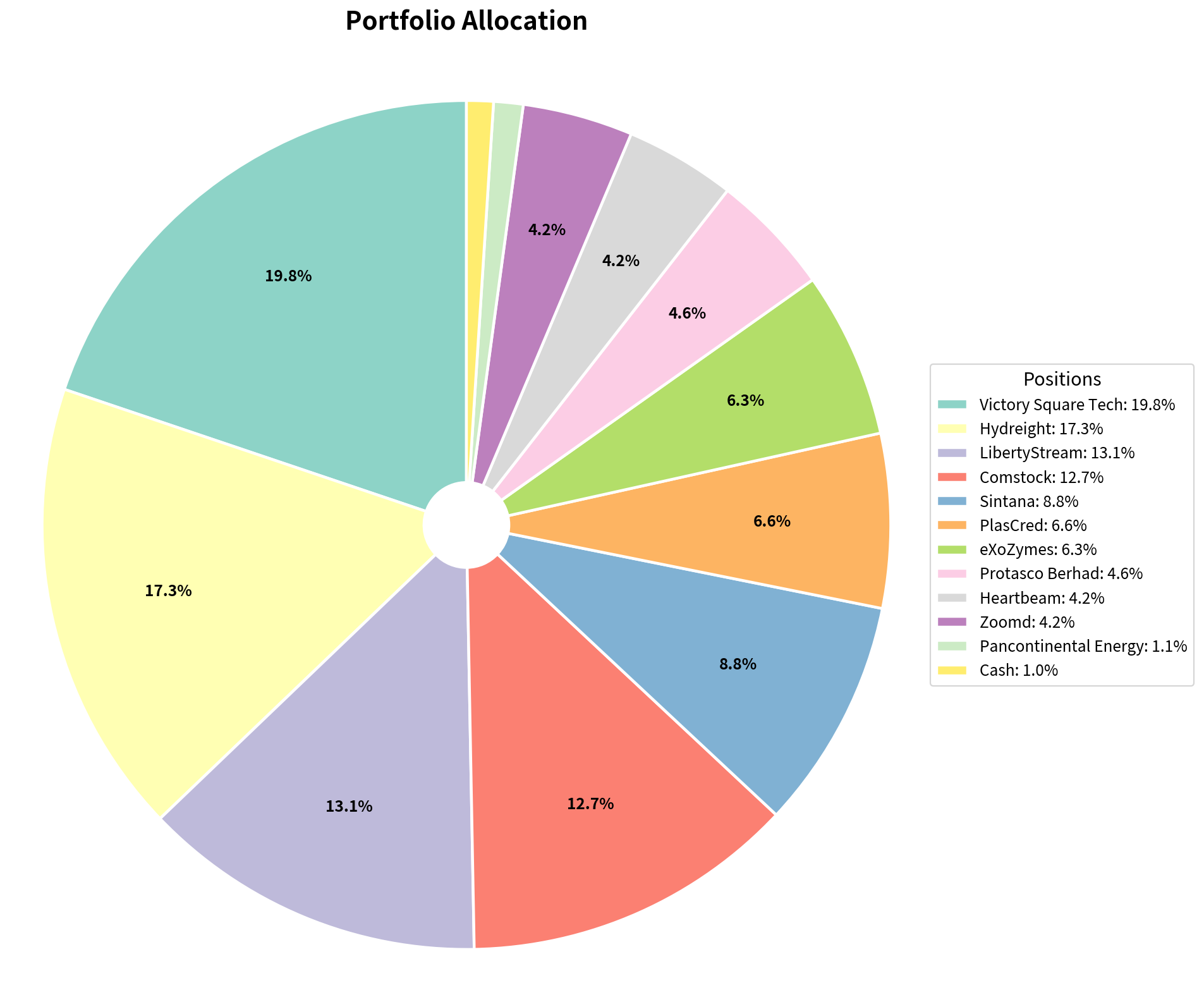
I haven’t sold anything since I posted this, but I did deploy most of the cash to buy a small position in Pancontinental Energy; this is my 3rd round, and to buy the dip on Libertystream and Heartbeam. And stock prices moving around are always changing the allocation, so for the presentation of the current allocation, I have constructed a new pie chart based on the last closing prices of each stock:
Percentage gain or loss against Cost Basis:
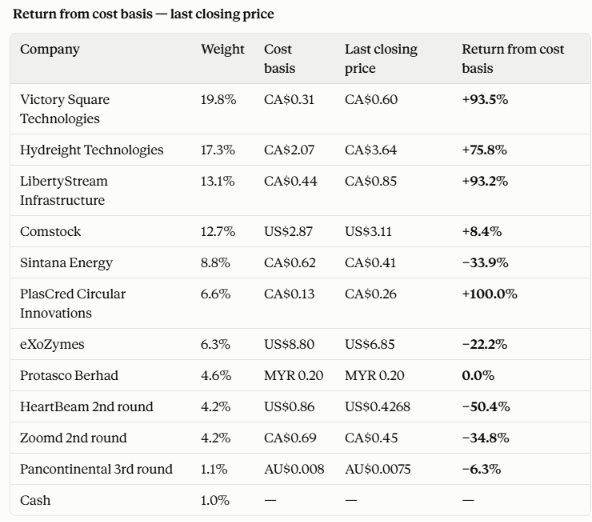
My portfolio has trended toward further concentration in my high-conviction picks, so for many of these positions the cost basis has moved noticeably higher (Hydreight, Victory Square, Libertystream) or lower (eXoZymes, Heartbeam, Zoomd 2nd round, Sintana) from my initial entry price.
This was about 10% of this article; the remaining 90% is behind the paywall and contains updates on each position, The List, and The Watchlist.

To access paid content for free, you can use the two buttons below to recruit new AlmostMongolian subscribers. Free subscribers count. The rewards are stacked.
$VST.CN Victory Square Technologies
and
$NURS.V Hydreight Technologies Update
…